 正版资源
音乐学院典藏乐器 SonicCouture The Conservatoire Collection
SonicCouture The Conservatoire Collection 是一套管弦乐类的古乐器音色库,收录的是按 16、17、18 世纪的传统工艺、以地道材料复刻出来的历史乐器。它解决的问题很具体:当配乐需要“比现代管弦更早”的声音时,用现代乐器去凑,音色总带着当下的光泽,压暗、加滤波也
网盘链接 · 支付成功后自动发货
永久有效 · 链接失效免费补发
每日 9:00-21:00 在线客服
SonicCouture The Conservatoire Collection 是一套管弦乐类的古乐器音色库,收录的是按 16、17、18 世纪的传统工艺、以地道材料复刻出来的历史乐器。它解决的问题很具体:当配乐需要“比现代管弦更早”的声音时,用现代乐器去凑,音色总带着当下的光泽,压暗、加滤波也不对味;这套复刻乐器给的是那个年代的声音底色。
用复刻古乐器补上配乐里的年代层
博物馆里的原件大多已有数百年历史,早就不在可演奏状态,所以这批乐器是按古法重新制作的高精度复制品。对创作者来说,它的意义在于多样性:现代乐器的前身在几百年间的形制差异远比今天丰富,这套音色把那种差异重新变成可用的声音调色板。它适合历史题材的配乐、纪录片与舞台音乐,也适合放进电子、氛围或极简作品里,作为一条“不属于今天”的独奏线条,与合成器、脉冲、噪声形成年代上的对撞。
在工程里摆放古乐器:声场、频段与动态
这类音色不适合被当成现代管弦的替代品来铺满,更稳的做法是让它承担独奏或小编制角色:
- 空间上给近到中场,不要一上来就挂大音乐厅混响,古乐器的亲近感一旦被推远就没了性格。
- 频段上与现代弦乐群、pad 做避让,独奏线条周围留出中频空隙,否则很容易被埋。
- 动态上别用总线压缩把它压平,起音的颗粒和演奏的呼吸感是它最值钱的部分。
- 与电子元素并置时,失真、滤波、颗粒延迟都可以用,但先确认原声那一层单独听仍然成立。
把它当作一件有历史身份的独奏乐器来对待,而不是又一层管弦铺底,这套音色在工程里的位置就清楚了。

伟大的作曲家的乐器现在是博物馆的作品。已有数百年历史,无法玩耍。
但是最近一段时间,乐器专家开始以再现乐器的形式重塑我们的音乐过去。
通过采购地道的材料并使用16、17和18世纪的传统技术,可以制作出极为精确的最精美的历史乐器。
这些美丽的新乐器将我们过去音乐的音景栩栩如生,向我们展示了现代乐器的前辈有多么难以置信的多样性。现在,我们能够更加忠实地进入我们的音乐传统,而新的声音调色板为当今的作曲家提供了新的灵感。
The instruments of the great composers are museum pieces now; hundreds of years old and not in playable condition.
But in recent times period instrument specialists have begun recreating our musical past in the form of reproduction instruments.
By sourcing authentic materials and using traditional techniques from the 16th, 17th and 18th centuries, incredibly accurate copies of the finest historical instruments can be produced.
These beautiful new instruments bring the soundscape of our musical past to life, showing us how incredibly diverse our modern instruments’ predecessors were. We are now able to enter into our musical heritage more faithfully, and the new palette of sounds available offers fresh inspiration for composers today.
01. French Harpsichord
This instrument is a copy of a harpsichord originally made by Paul Taskin in 1762 and later enlarged by Jean Goermanns in 1780.The original instrument is one of the most copied 18th century harpsichords, Michael Johnson’s copy is highly regarded as a faithful reproduction.
– Full tuning control with user selectable scales
– Two switchable 8′ string sets, with damping
– Key-off samples with level control
– Round robin samples for natural response
02. Flemish Harpsichord
A Michael Johnson copy of a harpsichord made by Johannes Ruckers, made in 1637.The copy used for the sample library was made in 2000 by Michael Johnson. Generally speaking, 17th century harpsichords are smaller, and, significantly, shorter than those of the 18th century.
– Full tuning control with user selectable scales
– 2 x 8′ with damping and 4′ string sets
– Key-off samples with level control
– Round robin samples for natural response
03. Theorbo
A single-strung, 14 course instrument made by Martin Haycock in 2005, after various seventeenth century Italian originals. This late Renaissance invention was the ultimate accompanying instrument of the time – by adding an extension to the neck, thick strings giving low notes were placed alongside the conventional lute meaning a player could play a bass- line and give the rhythm.
– Fret Hand postion control: gives you control over where on the fretboard the note will be played
– Full tuning control with user selectable scales
– Seperate release control for the frets and diapazon
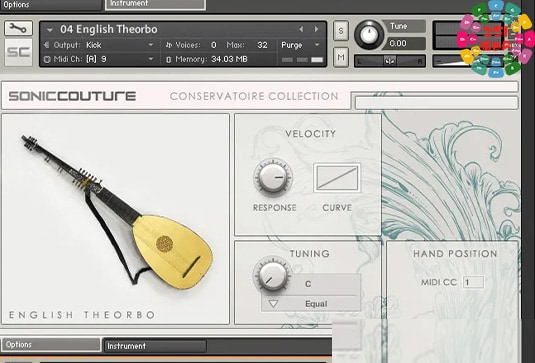
04. English Theorbo
Although there are no surviving original instruments, there are several descriptions, illustrations and paintings of English theorbos dating from the mid- 17th C. This instrumentwas made by Klaus Jacobson in 2005.The English theorbo has much in common with the small 12-course lute, from which it developed, but it takes elements of the larger, Italian theorbo, such as the deep body.
– Fret Hand postion control: gives you control over where on the fretboard the note will be played
– Full tuning control with user selectable scales
– Seperate release control for the frets and diapazon
05. Baroque Guitar
A French style, five- course instrument: a copy of various seventeenth century originals, made by Martin Haycock. The stringing of the instrument is unusual: the five courses correspond with the top strings of modern guitars, but they are double-strung apart from the top E. During the early 17th C, the guitar was primarily used as an accompanying instrument, playing for dances or accompanying singers.
– Fret Hand postion control: gives you control over where on the fretboard the note will be played
– Full tuning control with user selectable scales
– Convolution Room processor
06. Psaltery
The Psaltery is one of the oldest of all musical instruments, mentioned in the Bible and in numerous ancient Greek texts.
A Psaltery is a diatonic instrument, used to play chords or melodies. It is played by plucking the strings with quills, one in each hand. As the notes are not stopped by the player, the long decay time give this instrument an ethereal quality.
– Full tuning control with user selectable scales
– Round robin layers for natural response
07. Baroque Timpani
The successor to the nakers – primarily an outdoor instrument – was the timpani. Used at first for ceremonial occasions with trumpets, by the 18th century the timpani found a new home in the orchestra. The drums are smaller compared to their modern counterparts, they use calf-skin drum heads, and are tuned to different notes without the aid of pedals.
– 3 Articulations : Hit, Roll and Trill
– Selectable leather and wooden beaters
– Round robin layers for natural response
08. Renaissance Side-drum
This is a medium large drum with a long shell and skins at either end held in place by wooden rings. The skins can be tightened and on the lower skin there is a snare mechanism made from two gut strings.
– Stick, trill and roll articulations
– Round robin layers for natural response
09. Nakers
A naker is a small drum, of Arabic origin, with a metal or wood dome-shaped body and animal skin drum head. Played in pairs, nakers made their way to Europe at the time of the Crusades in the thirteenth century. The instruments sampled were copies of the pair in the Montagu collection.
– Left and right hand mapping
– Round robin layers for natural response
10. Hurdy Gurdy
This instrument is a copy of a sixteenth century original in the Gemeentemuseum, The Hague, and is typical of those of the late Renaissance.
A typical hurdy gurdy of the mid-Renaissance era featured three drones strings ( made of gut), two melody strings and a further higher drone string used for rhythm, known as the trompette. This features a buzzing bridge (chien – literally “dog”) which creates a harsh sound when the player increases pressure on the wheel. Traditionally, the player would play turn the wheel to the tempo of the music, using his wrist to effect a rhythm whilst turning the wheel. The last two strings (chanterelle(s)), are the melody strings.
The nature of the hurdy gurdy is one of an all-in-one melody, harmony and rhythm instrument. Even without the player consciously playing rhythmically, and playing without the melody strings chanterelles or the buzzing trompette drone, there is a natural rhythmic fluctuations with each cycle of the wheel.
– 3 Drone strings : G1, C2, G2 layout,
– 2 Chanterelle strings tuned in unison at G3.
– Trompette string : a higher C or “Tuned Up” to D.
– ‘Buzz key’ for rhythmic playing
– Key noise control
This is tested and fully working version.
Just add library to your KONTAKT and use.
Home Page
https://www.anonym.to/?http://www.soniccouture.com/en/products/28-ancient-rare-and-experimental/g30-the-conservatoire-collection/
同类资源
与当前资源同分类推荐 管弦乐
Kontakt 6.2.2 Win&Mac
永久有效 · 网盘发货
 管弦乐
最经典的电贝司 – Impact Soundworks Shreddage 3 Precision KONTAKT-DECiBEL
永久有效 · 网盘发货
 管弦乐
PAD铺垫合成器 – Sample Line Amazing Pads KONTAKT
永久有效 · 网盘发货
 管弦乐
经典日本游戏机音色 – borth-audio Gamble Kid KONTAKT-SYNTHiC4TE
永久有效 · 网盘发货
 管弦乐
独特的黑暗氛围音色 – Atom Hub – Ghosts Of Autumn for Kontakt
永久有效 · 网盘发货